English
 Русский
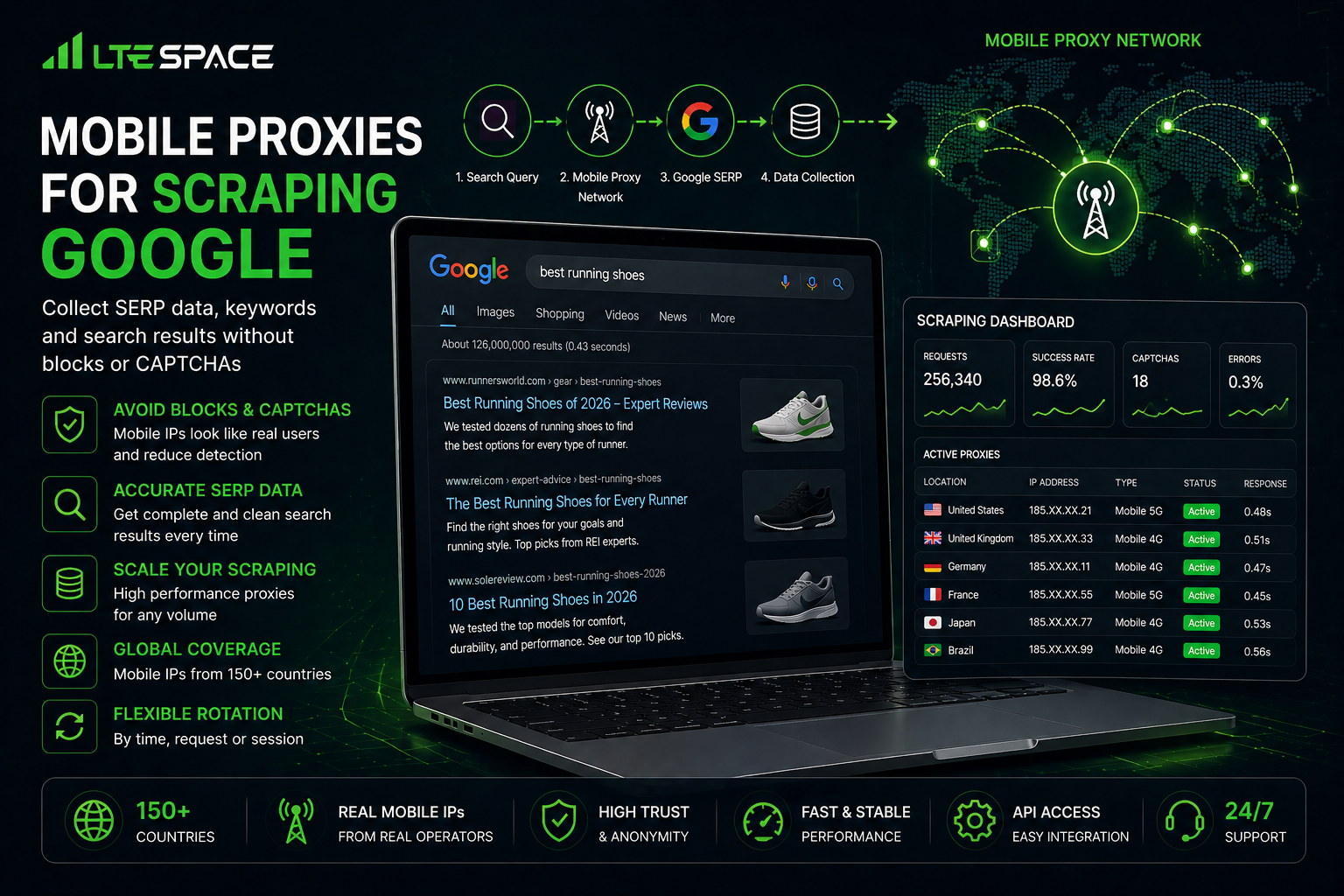
Mobile proxies for scraping Google are mobile carrier IP addresses that a scraper uses to collect search results, autocomplete suggestions and rankings without hitting a CAPTCHA wall after the first few hundred queries. In 2026, scraping Google costs more effort than it did two years ago: results now load only with JavaScript and arrive ten at a time, so the same dataset takes more requests and each IP carries a heavier load.
What changed in Google scraping by 2026
Two changes made in 2025 reshaped how search data is collected.
The first is mandatory JavaScript. Since January 2025, Google renders search results only for clients that execute the page scripts. A plain HTTP request without a browser receives a placeholder instead of results. Scrapers moved to headless browsers, which are heavier: every results page pulls scripts, styles and background calls, and all of that traffic passes through the proxy.
The second is the end of the num=100 parameter. Until September 2025, a single page could return one hundred results. Google now serves ten per page, so a full top-100 for one keyword takes ten requests instead of one. For a rank tracker checking thousands of keywords every day, that multiplies the number of requests coming from the same pool of addresses.
The practical outcome is that a scraper hits Google more often for the same amount of data, which makes the source of those requests more important than before.
How Google detects a scraper
Google does not rely on a single signal. It combines several of them:
- network — datacenter and hosting ranges are well known, and traffic from them faces stricter checks;
- frequency — dozens of queries per minute from one address do not look like a person;
- uniformity — identical intervals, the same sequence of actions, pagination with no pauses;
- browser — a headless fingerprint, no cookies, a browser language that does not match the country of the IP;
- address history — an IP that already sent automated traffic gets less trust.
The response escalates step by step. First comes the “Our systems have detected unusual traffic from your computer network” page with a reCAPTCHA. If the queries keep coming, the server starts returning HTTP 429, “Too Many Requests”. The worst case is silent: the page loads, but the results are trimmed or differ from what a regular user sees. That data lands in the report and skews rankings, while the scraper registers no error at all.
Browser signals are covered in more detail in the article on browser fingerprinting.
Why mobile IPs suit Google scraping
Mobile carriers route thousands of subscribers to the internet through a small pool of public addresses. This technique is called CGNAT, and it means that real people with phones sit behind every such IP at the same time. Google cannot ban that address for long without locking out ordinary users, so it treats mobile IPs more gently: it is more likely to show a CAPTCHA than to deny access. The mechanism is explained in CGNAT in mobile proxies.
Gentler treatment does not mean no limits. A mobile address still gets a CAPTCHA when it sends a stream of repetitive queries. The real advantage lies elsewhere: after an IP change, the scraper receives a fresh address from the same carrier pool rather than the next address in a datacenter subnet that is already flagged. Both address types are compared in the difference between mobile and datacenter proxies.
What data people collect from Google
Google scraping usually covers several distinct jobs:
- rankings — where a page stands for a keyword list, daily or weekly;
- autocomplete suggestions — the phrases Google offers while a query is typed, used for keyword research;
- SERP features — People Also Ask, answer boxes, video and shopping blocks;
- ads — which advertisers appear for a query and with what copy;
- local results — map listings and businesses in a specific city;
- competitor titles and descriptions — for snippet analysis.
These jobs put different loads on the proxy. Suggestions are short, light responses. A full results page with ads and SERP features is a heavy JavaScript page, and collecting it at a calmer pace pays off.
Region and language of the results
Google results depend on where the request comes from. The country is taken from the IP, and the interface language from the browser settings and query parameters. When the address points to one country while the language and parameters point to another, Google returns a mixed page, and the rankings in the report match no real audience.
Accurate data requires three things to line up:
- an IP address in the country whose results are needed;
- browser language and query parameters for that country;
- browser time zone and locale, if the scraper runs a full browser.
The countries where LTESpace offers mobile proxies are listed in mobile proxy geography. Checking rankings by city and region is a separate job, covered in mobile proxies for regional Google results.
Which LTESpace channel fits Google scraping
The choice depends on the request volume and on how the software handles connections:
- multiport — one entry point, and each new connection gets its own IP from the mobile pool. The number of parallel threads is chosen at purchase, up to 50. It fits rank trackers and keyword collection running dozens of threads. The plan is available for Russian carriers and is not meant for manual work in a browser. Details are in multiport mobile proxies;
- private channel — the address belongs to one user and changes through a link whenever the software asks for it, for example after a CAPTCHA. It fits sequential collection with a headless browser, where control over the moment of rotation matters;
- shared channel — the address changes on its own by a timer; intervals of 2 and 5 minutes are described for Russian plans. Several clients share the channel, so it suits small checks where price comes first.
Traffic is unlimited on every plan, which matters because a browser loads scripts and styles with every results page. The rotation methods are compared in the guide to mobile proxies with rotation.
How to set up collection without a CAPTCHA wall
- A browser, not bare requests. Without JavaScript there are no results, so the job needs a headless browser or a scraper built on one.
- Pagination on one address. The ten pages of a top-100 for one keyword belong to one session, not to ten different IPs: switching addresses halfway through looks odd.
- A human pace. Pauses between queries should vary instead of following a fixed interval. Fewer threads with pauses return more data than maximum threads without them.
- A check on every response. The scraper must tell a results page apart from a CAPTCHA page, a 429 response and an empty page. Such a response stays out of the report, and the query is retried later.
- An IP change after a CAPTCHA. When an address gets a CAPTCHA, it is better to rotate it and return to the keyword a few minutes later than to solve one CAPTCHA after another.
- Cookie consent. In Europe, Google shows a consent dialog on the first visit. It has to be accepted once in the browser profile, otherwise some queries return the dialog instead of results.
- Only the data that is needed. Collect what goes into the report: every extra page is another request from the same address.
General scraping rules — threads, pauses, sessions — are covered in proxies for web scraping. When the software needs a new address for every call, see proxy rotation per request.
If Google has blocked the proxy
A Google block on an address is almost never permanent. It is usually one of three situations:
- a CAPTCHA on every request — the address hit a temporary limit because of a stream of queries;
- HTTP 429 instead of results — Google is asking for a lower request rate;
- a constant “not a robot” check — the address has a bad history, which happens with free and datacenter proxies previously used for spam.
What to do, in order:
- Stop collecting through that address. Continuing to send requests through a blocked IP only extends the block.
- Change the address. On a mobile proxy the new IP comes from the carrier pool and carries none of the previous one’s history. On a private channel the address is changed through a link; on a shared one, the timer handles it.
- Find the cause. Most often it is too many threads, evenly spaced requests or a browser without cookies. Without fixing the cause, the new address will hit the same block.
- Return to the address later. A temporary limit on a mobile IP usually lifts on its own, since ordinary subscribers keep using the address.
Blocking an address and blocking a Google account are different things. When a proxy is used to sign in to email or an ad account, Google weighs the account history, the device and behavior, not only the IP. Changing the address does not help here, and changing it often triggers a check instead. Accounts need a fixed address, not rotation.
When a scraper is not needed
For a site owner’s own pages, Google Search Console reports impressions, clicks and average position directly, with no proxy and no scraping. A custom collector makes sense when the target is other sites, the full results page with ads and SERP features, other regions, or a daily ranking history across thousands of keywords.
Conclusion
Mobile proxies for scraping Google in 2026 solve the core problem of SERP collection: a carrier address does not end up in a long ban, and after a CAPTCHA it can be swapped for a fresh one from the same pool. The rest depends on the setup — a browser with JavaScript, a calm pace, matching region and language, and a check on every response. A channel for the planned volume can be chosen in LTESpace pricing.