English
 Русский
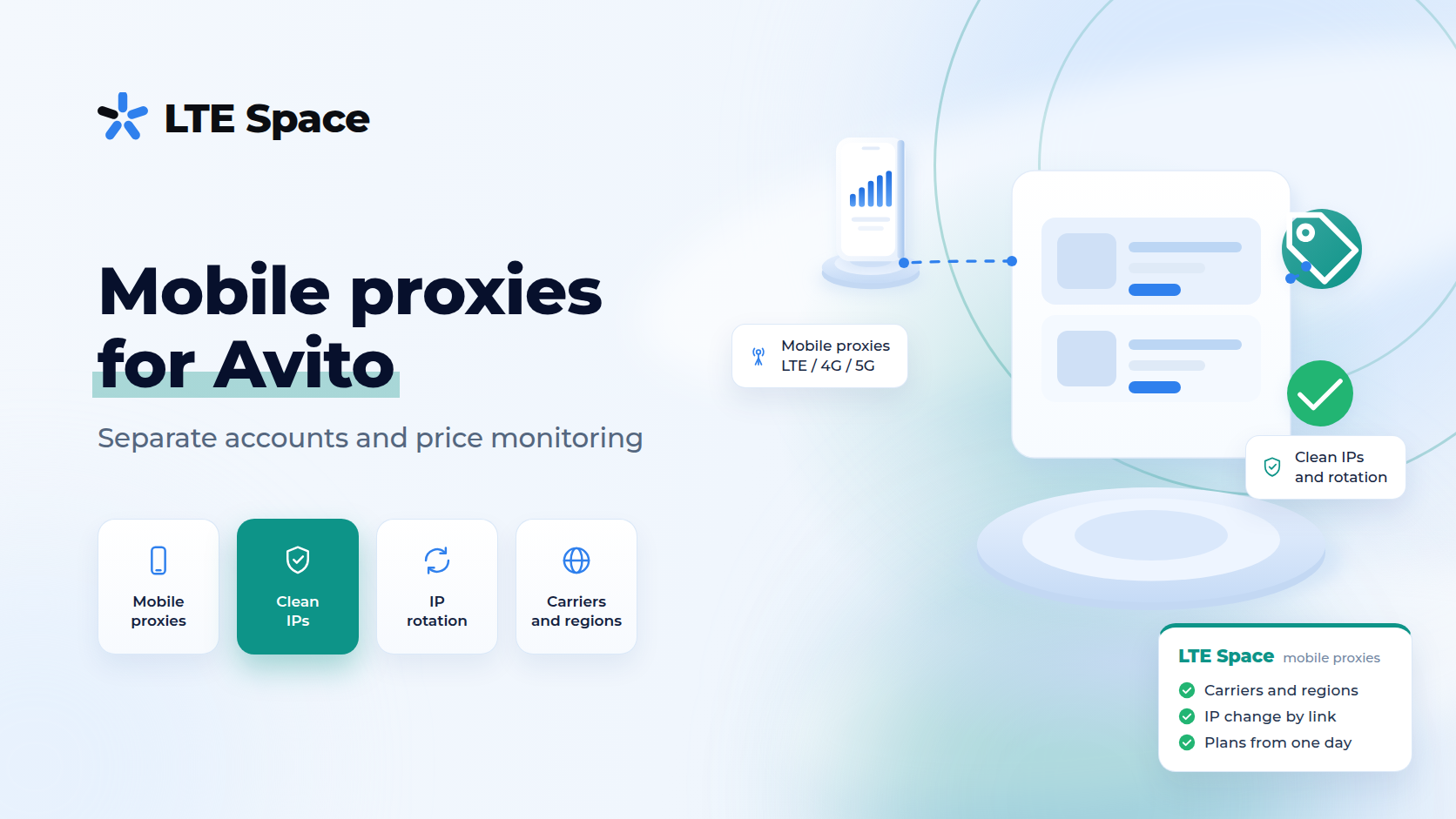
Mobile proxies for Avito give sellers, agencies and analysts Russian carrier addresses for working with Avito, the largest classifieds site in Russia. Avito is strict about who logs in and how: it filters datacenter addresses, links accounts that share an IP and quickly limits anyone who sends too many requests. A mobile address from a Russian operator looks like an ordinary buyer with a smartphone, which is why it is the calmest way to work with the platform.
Why Avito needs mobile addresses
- carrier addresses are shared — mobile networks put many subscribers behind one public IP, so Avito cannot block such an address without hurting real users, see CGNAT in mobile proxies;
- datacenter IPs are filtered — server addresses are easy to recognise and get more checks and captchas;
- the location must fit — an account that sells in Russia and logs in from abroad or from a server raises questions. A Russian mobile address removes that signal.
Separate accounts
Avito’s rules limit how one seller may use several profiles, and business sellers have official tools for that: company plans, bulk listing upload from a catalog file and an Employees section where a company grants access to its team. If the accounts belong to one seller and exist only to get around limits, proxies will not prevent restrictions: the platform links such profiles through products, texts, photos and contacts. Proxies are needed when accounts belong to different owners — for example, an agency or a freelancer running listings for several clients from one computer. Then each account works through its own address and its own browser profile, so the platform does not link unrelated sellers. Profile setup is covered in browser profile warm-up.
Price and competitor monitoring
Sellers track prices, new listings and competitors in their category. Avito limits frequent requests from one address and answers them with a CAPTCHA or a block, so collecting public data runs through rotating mobile addresses and moderate pauses. Working seller accounts are never used for collection.
An example. A seller needs competitor prices for a few hundred listings in their category every morning. Collection runs without signing in, through a shared channel or multiregion, with pauses between pages. The scraper checks every response: if a CAPTCHA arrives instead of the page, the request is retried later from a new address, and only real data reaches the table. General rules are in proxies for web scraping. For posting and managing listings, Avito offers an official API for business — start there rather than with page automation.
How an agency should run client accounts
An order that keeps different clients’ accounts from overlapping:
- One channel per client. Each client gets a separate private channel with a fixed address.
- One browser profile per account. Each account opens only in its own antidetect browser profile with its proxy set.
- Access without a password where possible. If the client operates as a company, access through the Employees section is more convenient than the profile password.
- A mapping table. Which address and profile belong to which client is written down, so nobody opens an account from the wrong address.
- No moves. An account does not move to another address without a reason: every change is a new reason for confirmation.
How Avito reacts to suspicious logins
- a new address and a new device — a confirmation code request;
- many accounts on one IP — checks and account linking;
- a datacenter address — more confirmations and CAPTCHAs;
- a sudden region change within one session — looks like someone else signing in.
Hence the rules: one account, one fixed address; the address is Russian; when a confirmation is requested, the address stays the same and the check is completed from that IP.
Address region
The city of an Avito listing is set in the listing itself, not by the address it was posted from. A proxy from another city therefore does not make a seller “local” and does not move the listing to another region.
The address region matters for two things. The first is consistency: an account that always works from Kazan is better kept on a Kazan or at least a stable address. The second is search checks: seeing results the way a buyer in another city does is easiest from an address in that city, in a separate profile without signing in to the working account.
Which channel to choose
- a private channel — for accounts: assigned to one user, the address changes only on the user’s command, by a special link;
- a shared channel — the address changes on its own on a timer; for Russian plans the interval is 2 or 5 minutes;
- multiregion — exits through different regions of Russia with an address change every 2 minutes, for monitoring that needs many regions;
- multiport — one entry point where every new connection gets its own IP, for parallel data collection, see multiport mobile proxies.
What proxies do not solve
- a banned listing stays banned: changing the IP does not undo a moderation decision;
- identical texts and photos in several accounts link them regardless of addresses;
- breaking Avito’s rules on multiple accounts leads to restrictions from any IP;
- mass actions without pauses look like automation, even from a mobile address.
How to connect and test a proxy
The proxy goes into an antidetect browser profile or into the settings of an ordinary browser:
- mobile proxies in Dolphin Anty — for several accounts;
- set up mobile proxies in Google Chrome;
- set up mobile proxies in Firefox.
A free test is worth taking before buying: after registration, technical support issues test proxies that work for 2 hours. That is enough to check an account sign-in and loading the pages needed. A longer check fits the one-day plan.
Summary
Mobile proxies for Avito keep separately owned accounts apart and make price monitoring possible without running into limits. An account needs a steady Russian address, data collection needs rotating addresses, and listing management works best through Avito’s official tools. Russian mobile channels are in the LTESpace plans.
The same principles apply to Russia’s largest social network, see proxies for VKontakte.